Tadawul is the Saudi Stock Exchange, the largest equity market in the Arab world by market capitalisation. Its defining moment remains December 2019, when Saudi Aramco listed and raised $25.6 billion in the initial offer, later lifted to about $29 billion after the greenshoe option was exercised, the largest initial public offering on record anywhere. The listing briefly pushed Tadawul's total capitalisation above $2.5 trillion.
The exchange trades Sunday to Thursday and hosts the kingdom's blue chips: Aramco in energy, Al Rajhi and SNB in banking, Almarai in food, Saudi Telecom in telecoms, and a deep mid-market of family businesses that listed during the 2019-2023 privatisation push. For investors approaching Gulf equities, Tadawul is the region's benchmark market and the one global index funds must own.
From domestic club to indexed market
Three reforms made Tadawul globally investable. First, qualified foreign financial institutions were allowed to buy shares directly from June 2015, opening a market that had been closed to outsiders beyond swap workarounds. Second, in 2019 the exchange was admitted to emerging-market indices by MSCI and FTSE Russell, triggering passive inflows measured in the tens of billions of dollars. Third, the 2019 Aramco listing put a single stock worth more than most regional exchanges combined into the index.
The exchange itself is owned by Saudi Tadawul Group, which listed in 2021, and its regulation sits with the Capital Market Authority. Settlement moved to T+2, delivery-versus-payment was introduced, and market-making rules were modernised to match the index providers' operational requirements.
What trades there
| Segment | Contents |
|---|---|
| Main Market | Largest Saudi and dual-listed companies |
| Nomu Parallel Market | Lighter requirements; qualified investors only |
| Sukuk and bonds | Government and corporate issuance programmes |
| ETFs and REITs | Including the region's biggest listed REIT sector |
Nomu, launched in 2017, has become the testing ground for smaller listings, and the exchange's REIT sector, created under 2016 Capital Market Authority rules, is the largest in the Gulf.
How foreigners actually access it
Qualified foreign institutions register with the exchange and hold custody through local brokers, while retail investors abroad typically buy Saudi exposure through ETFs and funds. Ownership limits apply at the stock level for strategic companies, and Aramco itself trades on the main market with the government holding the overwhelming majority of shares.
Practical contrast with the UAE, where buying directly is simpler: our guide to buying shares on the Dubai Financial Market walks through the investor-number process there, which requires no institutional qualification.
The market's capitalisation means its membership is complete: the region's decisive companies, from the world's largest oil producer to its largest lender by assets, trade in Riyadh, and no serious Gulf portfolio, passive or active, exists without Saudi exposure. That completeness, bought with the 2019 listing, is Tadawul's real asset.
What drives the index
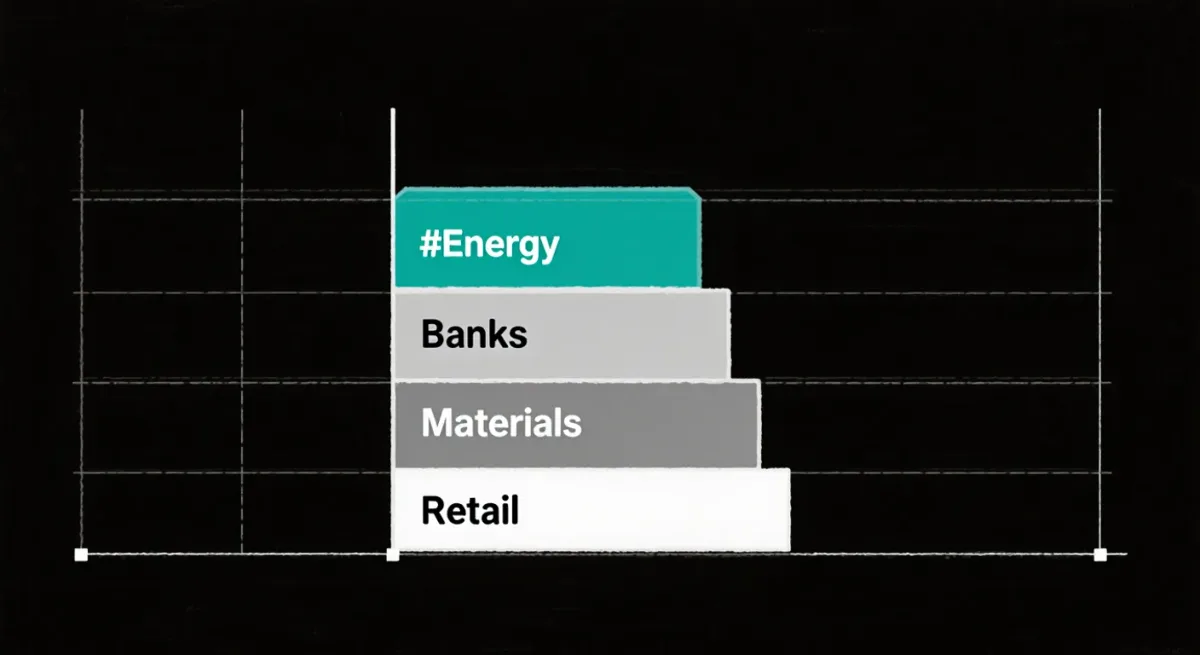
Two forces dominate: oil-linked petrochemicals and Aramco on one side, and a domestic demand complex of banks, retailers and property on the other. Policy is a third: the privatisation pipeline under Vision 2030 has fed the listing calendar, and government-related share sales set the supply rhythm. Because the riyal is pegged to the dollar, monetary conditions are imported wholesale, and rate cycles pass through bank margins much as they do across the Gulf.
Liquidity is the honest caveat. Tadawul's free float is thinner than headline capitalisation suggests, because state and founding families hold large blocks, so index weightings and tradable weight can diverge sharply in the largest names.
How trading actually runs
The operating week is Sunday to Thursday, with a pre-opening auction, continuous trading and closing auctions following the exchange's published calendar. All orders route through licensed Saudi brokers; settlement is T+2 through the exchange's central counterparty, and custody for foreign institutions sits with local custodians approved by the Capital Market Authority. Price limits cap daily moves in individual names, a feature inherited from the market's retail-heavy history, and these limits occasionally produce multi-day limit runs in small-cap names that visiting investors mistake for liquidity.
The investor base is the market's defining texture. Saudi retail investors account for a large share of turnover, higher than global norms, and their momentum-following behaviour gives Tadawul a distinctive volatility signature: heavy volume in rallies, sharp retail-driven drawdowns in risk-off phases, and an institutional core, the state pension apparatus, the Public Investment Fund and foreign passive funds, that provides the stability underneath. The Nomu parallel market, by contrast, restricts access to qualified investors and trades accordingly thinly.
A short history in five dates
| Year | Event |
|---|---|
| 2003 | Capital Market Authority established, ending decades of unregulated share trading |
| 2015 | Qualified foreign financial institutions admitted to direct ownership |
| 2017 | Nomu parallel market launched |
| 2019 | MSCI and FTSE Russell emerging-market inclusion; Aramco lists in December |
| 2021 | Tadawul's own parent group lists on the exchange |
The compressed sequence matters for expectations: this is a market whose institutional plumbing is barely a decade old in its modern form, and the pace of rule change, short-selling introductions, derivatives launch, market-making expansions, has been a defining feature rather than an exception. Investors coming from mature exchanges should read the rulebook annually, not once.
Why it matters beyond Saudi Arabia
Tadawul's size makes it the Gulf's pricing reference: when global funds rebalance emerging-market exposure, flows through Riyadh move neighbouring bourses by sympathy. Its IPO pipeline, from the state's privatisation programme to family-business successions, sets the region's equity capital markets agenda, and its sukuk calendar anchors Islamic fixed-income benchmarks.
A first-timer's summary: Tadawul is a large, indexed, oil-and-banks market with an improving rulebook, priced in a dollar-pegged currency, where the state is the anchor shareholder of the anchor stock. That last fact is the one to remember.