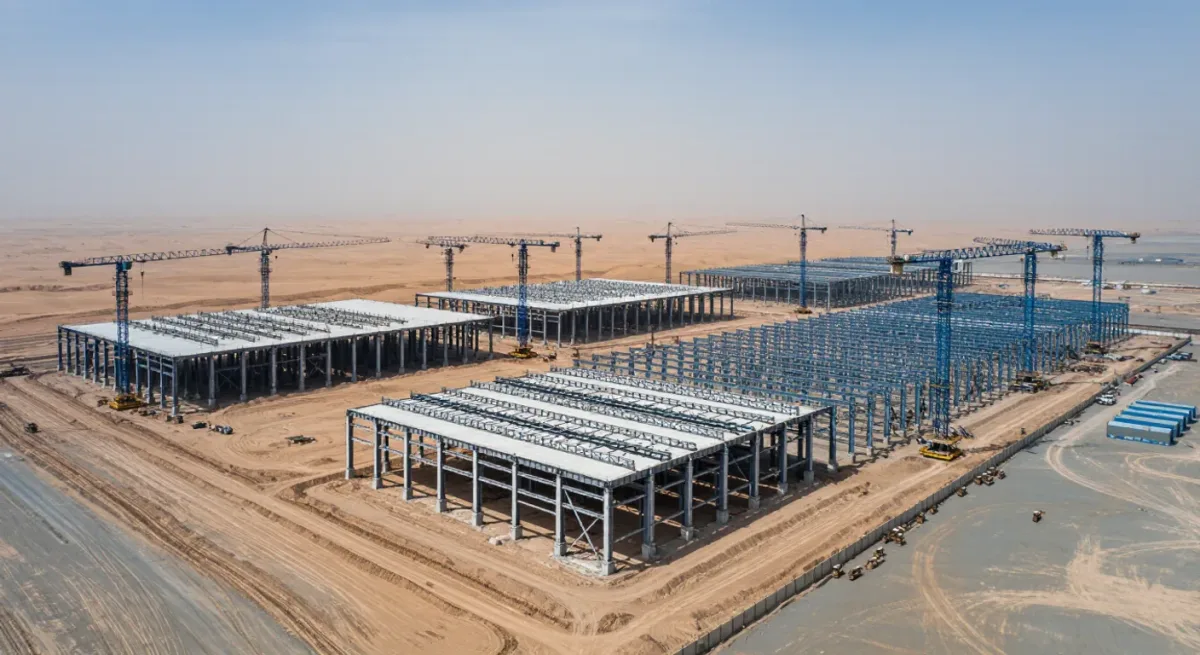
Stargate UAE is a planned AI supercomputing campus in Abu Dhabi with a target capacity of five gigawatts, announced in May 2025 during the US president's state visit as the first international expansion of the Stargate infrastructure programme launched by OpenAI, Oracle and SoftBank. The founding partners include G42 as the UAE anchor, with NVIDIA and Cisco supplying compute and networking, and OpenAI's published plans describe an initial 200-megawatt deployment ahead of the full build.
The scale is the story. Five gigawatts is roughly the continuous peak demand of a mid-sized country's grid, devoted entirely to training and running AI models, and it positions Abu Dhabi's AI infrastructure as the largest single frontier-compute site outside the United States.
The deal architecture
| Partner | Role |
|---|---|
| G42 | UAE anchor investor and local operator |
| OpenAI | Model platform and anchor tenant of the compute |
| Oracle | Cloud build-out and operations |
| NVIDIA | GPU compute supply |
| Cisco | Networking infrastructure |
| SoftBank | Financing and strategic investment |
The arrangement mirrors the US Stargate campuses announced from January 2025, with a Gulf addition: reciprocal access. US partners gain a hosting beachhead in the region, and Emirati institutions gain proximity to frontier training workloads.
Why Abu Dhabi, and why now
Three conditions aligned. Capital: Abu Dhabi's sovereign system can underwrite decade-scale infrastructure without financing risk. Energy: the emirate can dedicate power, gas, nuclear and increasingly renewables, to a load of this size, the constraint that has stalled similar projects elsewhere. And politics: the May 2025 visit produced a technology framework that cleared US export-policy comfort for frontier compute in the Gulf, resolving the obstacle that had capped earlier NVIDIA shipments to the region.
For OpenAI, the campus extends its compute position beyond US soil at a moment when capacity is the industry's binding constraint; for the UAE, it converts energy wealth into the asset the AI economy actually shortages.
What has happened since
The announcement framed a multi-year build: land, power interconnection and phased compute halls, with the first 200 megawatts planned as the initial deployment, per OpenAI's statements at signing. Construction timelines for projects of this class run years, and updates have come through partner disclosures rather than a single tracker, so progress watchers monitor Oracle's regional filings, NVIDIA's shipment commentary and UAE energy-consent notices.
The strategic context for the UAE's side of the bargain, the national strategy that Stargate serves, is covered in our explainer on the UAE AI strategy.
The risks, plainly
- Export policy: the project rests on US approval remaining stable; a policy reversal could strand phases mid-build, a risk every party prices.
- Power sequencing: five gigawatts arrives in grid-steps, and any slip in generation or interconnection delays compute revenue.
- Demand concentration: the campus's economics assume frontier-model demand keeps compounding; a model-efficiency shock could change the calculus.
- Geopolitics: the region's 2026 conflicts underlined physical-risk exposure for concentrated infrastructure anywhere in the Gulf.
Abu Dhabi as an AI geography
The naming, and what it borrows
The Stargate name arrives from the US programme announced in January 2025, the private venture in which the same partners, OpenAI, Oracle and SoftBank, committed to gigawatt-scale compute campuses on American soil. Extending the label to Abu Dhabi was a deliberate act of franchising: the same coalition, the same architecture, a second geography. For the UAE, borrowing the brand signals parity of seriousness with the original, and for the partners it signals that frontier compute is now a multi-jurisdiction asset class, sited where power, capital and politics align. That alignment is the deepest reason the project matters: it demonstrates that the AI build-out's centre of gravity is negotiable, and Abu Dhabi negotiated its way inside.
Stargate lands in a city that spent a decade preparing for it. Abu Dhabi holds the region's densest AI institutional cluster, the university, the research institutes, the sovereign funds with US technology stakes and the G42 infrastructure, and its power system, gas generation backed by nuclear and growing renewables, can firm a multi-gigawatt load with a flexibility few geographies offer. The emirate's planners have been explicit that AI infrastructure is the next pillar of an economy built successively on oil, finance and tourism, and the campus is the pillar's foundation stone. The scale deserves visualising: five gigawatts of compute is a city of data centres, power plants and cooling loops, a construction programme that will employ thousands and, once running, a permanent industrial district with an energy bill larger than most towns' entire consumption.
| Input | Order of magnitude for 5 GW of compute |
|---|---|
| Power | A mid-sized country's peak demand |
| Capital | Tens of billions of dollars over the build |
| Water or air cooling | Industrial-scale heat management |
| Workforce | Thousands in construction, hundreds permanent |
The campus also repositions the region's internal competition. Dubai built its economy on trade and services; Riyadh is building on state-directed demand; Abu Dhabi's play is compute, the raw material every other ambition now requires. If Stargate delivers, the emirate becomes the Gulf's AI landlord, hosting the workloads its neighbours' strategies consume, a role with better economics than competing for the same tenants.
Why it matters
Stargate UAE is the clearest single test of whether frontier AI infrastructure globalises or stays American. If it delivers gigawatts on schedule, the Gulf becomes a third pole of AI compute alongside the US and China's closed ecosystem, and Abu Dhabi's decade of positioning, the strategy, the partnerships, the Microsoft alignment, will have converted into concrete. If it stalls, the region's AI story reverts to data-centre periphery. The megawatt meter, published or not, is the scoreboard.