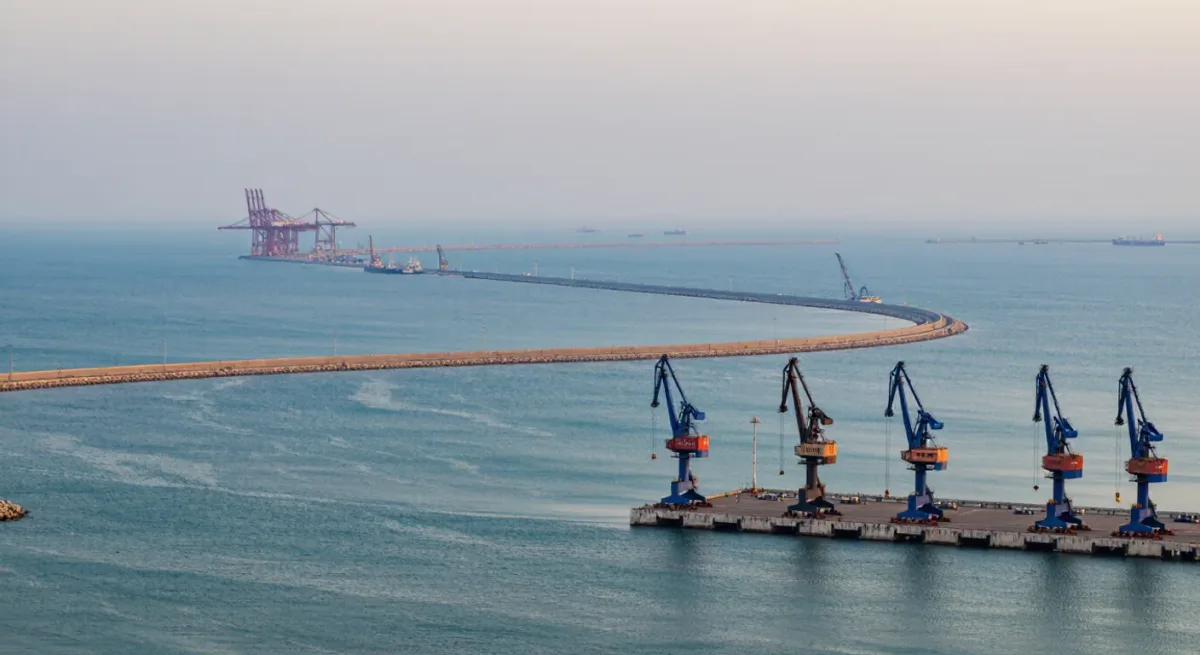
Duqm is Oman's special economic zone on the Arabian Sea coast, created by royal decree in 2011 and covering roughly 2,000 square kilometres, an area larger than some cities, around a deep-water port deliberately sited outside the Strait of Hormuz. Its anchors are physical: a port and shipyard cluster including one of the region's largest dry docks, a 230,000-barrel-per-day refinery built as a joint venture between Oman's OQ and Kuwait's international refining arm, an airport, and land banks for industry and tourism.
The strategic pitch is geography twice over. Duqm faces the Indian Ocean shipping lanes that carry Asia-Europe trade, and it lies beyond Hormuz, the chokepoint that concentrates Gulf risk, a consideration the 2026 regional conflict sharpened for every logistics planner. For Oman's economy, Duqm is the largest single bet on diversification from a state with thinner hydrocarbon margins than its neighbours.
What is built and running
| Asset | Status |
|---|---|
| Port of Duqm | Operating; deep-water berths and liquid bulk capability |
| Oman Drydock | Operating; one of the region's largest ship-repair yards |
| Duqm refinery | 230,000 bpd JV between OQ and Kuwait's KPI, commissioned this decade |
| Duqm Airport | Built and handling flights |
| Fisheries and tourism clusters | Developing, including hotel and marina projects |
The economic logic
Oman cannot match Emirati or Saudi subsidies, so Duqm sells location and cost: cheaper land, cheaper power potential, and a position on corridors that Gulf ports inside Hormuz cannot replicate. Chinese and regional industrial investors have taken leases, the fishery cluster processes one of Oman's strongest natural resources, and the refinery anchors a petrochemical downstream. Green-hydrogen studies cluster along the adjacent coast, where wind and sun resources rank among the region's best.
The zone's contribution to the non-oil diversification story across the GCC, where Oman plays a distinct lower-cost role, is covered in our explainer on the size of the Gulf's non-oil economy.
The honest ledger
Duqm's history is a reminder that zones run on patience. Announced ambitions a decade ago described hundreds of billions of dollars in committed projects; delivered investment is a fraction of that, the global norm for megazones from Africa to Southeast Asia. Population remains thin outside the industrial workforce, social infrastructure is still building, and the refinery's startup slipped repeatedly before commissioning. What distinguishes Duqm from failed zone projects is that its core assets, port, drydock, refinery, exist and operate, generating the cash flows that finance the next phases.
Who should care
- Industrial and logistics tenants: land and energy costs competitive with, and often below, northern Gulf alternatives.
- Shipping and repair operators: drydock capacity and an out-of-Hormuz position.
- Energy investors: refinery downstream, minerals processing and hydrogen-adjacent opportunities.
- Policy watchers: Oman's debt-constrained model is a live test of megazone economics without sovereign wealth.
The city that follows the port
Zones live or die by their second generation, the housing, schools and clinics that make a workforce stay, and Duqm's planners have treated the city as deliberately as the industry. The master plan pairs the port and industrial belt with residential districts, a university site, hospital capacity and tourism anchors on the coast, phased to workforce growth rather than ahead of it, the lesson of the region's ghost-district projects applied from the start. Delivery has followed the same incremental logic: population remains modest, measured in tens of thousands against ambitions in the hundreds, but the components, airport, hospital, marina and hotel stock, exist, which distinguishes Duqm from projects that announced cities and built fences. The wager, as ever with Oman, is patience priced in rials of cheap coastline, and the 2020s have so far rewarded it slowly.
Duqm against its regional comparators
Gulf industrial-zone history gives Duqm its reference class, and the comparison is instructive. Jebel Ali, the prototype, paired a zone with a port and a national market and became the region's success story. Saudi Arabia's city-scale projects pair sovereign wealth with domestic demand on a scale Oman cannot copy. Duqm's honest comparators are the second-tier success stories: Salalah's port-and-free-zone combination to Oman's south, which built a transshipment business on Indian Ocean routing, and Khalifa Port's industrial zone in Abu Dhabi, which converted a greenfield port into a manufacturing cluster within a decade. Duqm's differentiation against both is location outside Hormuz and cheaper energy and land, and its test is the same one that zone economics always applies: whether anchored assets generate the secondary investment that turns a project into a place.
| Model | Example | Lesson for Duqm |
|---|---|---|
| Port plus national market | Jebel Ali | Scale Oman lacks |
| Sovereign giga-project | Neom-class projects | Capital Oman lacks |
| Niche port success | Salalah | The achievable template |
| Greenfield industrial | Khalifa Port zones | Anchor-tenant playbook |
The zone's fiscal context is the quiet variable. Oman's debt-reduction years tightened state investment, and Duqm's later phases lean on foreign and GCC capital, the Chinese industrial leases, the refinery's partners and the tourism developers, rather than sovereign spending. That constraint has produced a more commercially disciplined project than the region's sovereign-funded megazones, slower to build but with each phase carrying its own investor discipline, and for tenants it means a counterparty that needs them, which is not the worst negotiating position in the Gulf.
How to engage
The Special Economic Zone Authority at Duqm, SEZAD, is the single window for land, licensing and utilities, and OQ, the state energy company, partners on energy-side ventures. Timeline realism matters: leases are long, incentives phase with delivery milestones, and the zone rewards investors whose business case survives a slow first decade.
The summary: Duqm is the Gulf's biggest bet on coastline rather than capital, a working port-refinery complex with two decades of building left to do, and the out-of-Hormuz card that 2026's shipping disruptions made newly valuable.