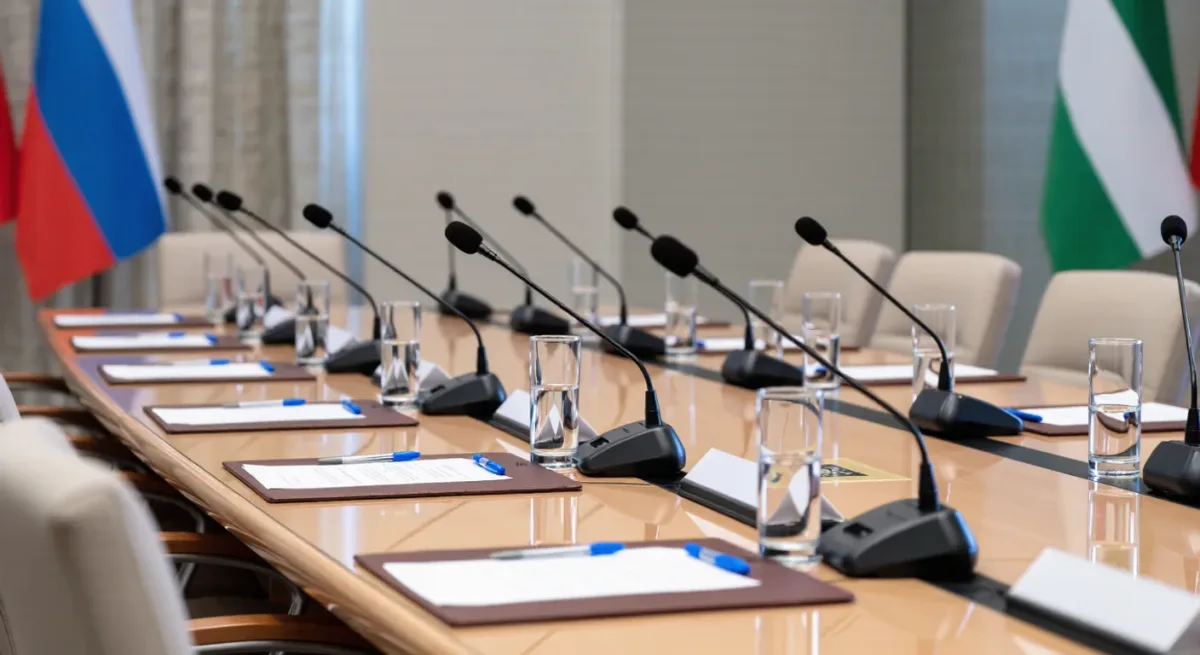
US President Donald Trump announced on July 30, 2026 that the Board of Peace had reached what he called a historic agreement for the complete disarmament of Hamas and other armed groups in Gaza, posting on Truth Social that Gaza would be in the hands of a new Palestinian government. Saudi Arabia formally welcomed the announcement on July 31, reaffirming its commitment to implementing the agreement, the Saudi Gazette reported.
The agreement, based on Trump's 20-point ceasefire plan, calls for Hamas to surrender its weapons and destroy its tunnel network and includes an Israeli withdrawal from Gaza, according to details reported across regional and international media. A senior Hamas official told the BBC the movement had agreed to the Board of Peace's plan, while some Israeli ministers reportedly viewed the terms as problematic and Israel had not officially commented at the initial reporting.
The Gulf's role and stakes
Trump credited Egypt, Qatar and Türkiye for their roles in reaching the deal, continuing the mediation structure that produced earlier ceasefire rounds. For Gulf capitals, the agreement opens the question they have positioned around for years: regional reconstruction economics, and in particular Saudi Arabia's price for normalisation with Israel, which officials have consistently tied to a credible path to Palestinian statehood.
| Event | Date |
|---|---|
| Trump announces disarmament agreement | July 30, 2026 |
| Saudi Arabia welcomes the announcement | July 31, 2026 |
| Hamas official signals acceptance to BBC | Late July 2026 |
| Israeli government position | Unofficial at first reporting |
What the deal contains
Reported elements include disarmament of armed factions, destruction of the tunnel network, an Israeli withdrawal, and administration of Gaza by a new Palestinian government under the plan's governance provisions. Implementation machinery, sequencing, monitoring and reconstruction financing, was the immediate focus of follow-up diplomacy, and the region's recent record argues for caution: previous ceasefire frameworks produced partial calm and repeated breakdowns.
The reconstruction economy, if it holds
Gulf states are the natural financiers of any Gaza rebuilding programme, and their engagement would follow the pattern set in Egypt, Jordan and the Palestinian territories over decades: state development funds, contractor deployments and political conditions attached. Early analyst commentary priced reconstruction in the tens of billions of dollars over years, a figure consistent with the destruction surveys from the war years. Regional contractors, materials suppliers and engineering firms across the Gulf watch these announcements as pipeline events, even at announcement-stage risk.
The diplomatic sequence also touches the other file the region tracks: the Saudi-US relationship and its investment dimensions, on which our coverage of Qatar's mediation-centred statecraft, including the mourning period for the Father Amir, provides regional context.
What to watch
- Official Israeli acceptance or amendment of the terms, the single largest variable.
- A Board of Peace implementation schedule with dates and monitoring arrangements.
- Weapon handover and tunnel decommissioning verification mechanics.
- Gulf reconstruction financing pledges, which follow credibility, not announcements.
The reconstruction question, priced
If implementation begins, the money conversation starts immediately, and its scale is knowable from precedent. Damage assessments across the territory after years of war run to tens of billions of dollars in housing, utilities and infrastructure alone, and regional rebuilding programmes of comparable scale, Iraq's reconstruction rounds, Lebanon's repeated plans, provide the template: pledging conferences, state development funds as executors, and Gulf contractors as delivery muscle. The Gulf states have both the capital and the engineering capacity to fund and build a Gaza programme at scale, and their diplomacy has positioned them to lead it; what every previous cycle taught, and what officials privately acknowledge, is that money follows governance, an administration able to certify projects, receive funds and be audited, and the Board of Peace framework's governance provisions are therefore the financial schedule's real gate.
| Stage | Financial significance |
|---|---|
| Disarmament verified | Unlocks donor conference timing |
| Governance installed | Determines who can receive and disburse funds |
| Israeli withdrawal sequenced | Sets reconstruction access windows |
| Pledging conference | Gulf commitments expected to anchor totals |
How the Gulf press read it
The region's own coverage divided on predictable lines that nonetheless reveal the Gulf's stakes. Saudi outlets led with the kingdom's welcome and its decade-long advocacy of a two-state path; Qatari coverage foregrounded the mediation credit Doha earned alongside Cairo and Ankara; Emirati papers emphasised the reconstruction and stabilisation dividend. No serious Gulf editorial treated the announcement as an end, all treated it as a beginning the region is positioned to shape, which is both the accurate reading and the one the region's investments, diplomatic and financial, are now placed to test.
The regional stakes beyond Gaza
For the Gulf's markets, the announcement's first-week effect was visible in the usual instruments, regional risk premia and equities, both of which had already priced a diplomatic floor under the year's escalation, and both of which now await verification dates rather than statements.
Three larger files hinge on the agreement's fate. Saudi normalisation with Israel, frozen pending a credible Palestinian track, moves if implementation holds, with consequences for the region's investment geography. The Iranian-linked escalation calendar, which Gulf capitals have spent the year pressing Washington to quiet, loses its most active front if Gaza's factions disarm. And the Gulf states' own security doctrine, diplomacy-first, loudly vindicated if the mediation coalition's framework holds, suffers if it collapses into another episode. The July 30 announcement is therefore not only a Gaza story; it is the region's near-term direction expressed in a single negotiating text, and every Gulf capital treated it accordingly.
The assessment
July 30's announcement is the most complete framework the conflict has produced, and its Saudi endorsement within a day signals Gulf buy-in at the highest level. The honest reading, shared quietly across the region's chancelleries, is that announced agreements in this war have repeatedly marked beginnings of processes rather than ends of them. The Gulf's welcome is real; the Gulf's money will follow proof.