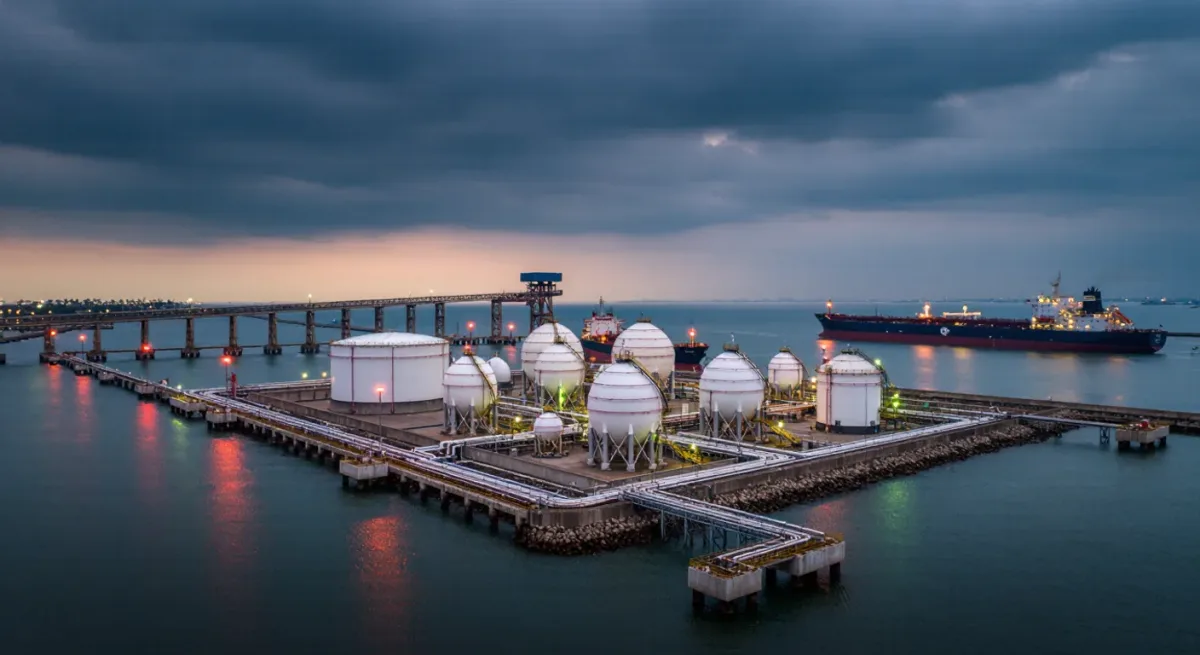
Qatar is mid-way through the most consequential industrial repair in the history of the LNG business. The March 2026 attack on Ras Laffan Industrial City, the world's largest liquefaction complex, damaged Trains 4 and 6 and knocked out approximately 12.8 million tonnes of annual capacity, 17 percent of Qatar's export capability, with repairs estimated at three to five years and lost revenue of up to $20 billion a year, according to a Reuters report citing QatarEnergy assessments published on March 19, 2026.
Five months on, the market consequences have held the shape analysts drew at the damage assessment. Global LNG prices remain volatile with a structural squeeze, forecasters abandoned their well-supplied 2026 outlooks, and discussion of force majeure declarations by QatarEnergy on affected contract volumes moved from possibility to active negotiation with buyers, as Indian importers reported. For the global gas market, the repair clock, not the news cycle, now sets the tempo.
The damage, precisely
| Item | Assessment |
|---|---|
| Facilities damaged | Trains 4 and 6 at Ras Laffan |
| Capacity offline | About 12.8 mtpa, roughly 17 percent of exports |
| Repair timeline | Three to five years per QatarEnergy estimates |
| Revenue impact | Up to $20 billion annually |
| Unaffected | Remaining trains and the North Field expansion construction |
Buyers adjust
India carries the sharpest exposure: Qatar supplies more than two-fifths of India's LNG imports, and Indian buyers negotiated cargo schedules and diversion options through the spring. European utilities, competing for the same spot cargoes, bid up Atlantic basin supply, while Asian contract holders weighed allocation formulas written for an undamaged Qatar. The episode has become the case study for diversification arguments across importing countries, and a reminder that single-source concentration cuts both ways, for the exporter's revenue and the importer's security alike.
The financial engineering
Qatar's treasury approaches the repair from strength: the sovereign wealth fund's assets, built on gas surpluses, buffer the revenue hit, and the undamaged trains continue earning at elevated prices, a partial natural hedge the $20 billion estimate already nets. Analysts' attention has shifted to the rebuild's engineering logistics, replacement cryogenic components have multi-year lead times globally, and to insurance recovery, the largest energy-damage claim the market has processed in decades.
The strategic read, covered from the market side in our oil-supply analysis of OPEC+'s completed rollback, is that 2026 tightened gas while loosening oil, an unusual divergence that reshaped relative energy prices and re-priced Gulf hydrocarbon risk across the board.
The expansion, revised
Before the attack, Qatar was executing the largest liquefaction build-out ever attempted, lifting capacity from 77 toward 142 million tonnes a year by 2030 across the North Field projects. The undamaged expansion trains continue construction, and Qatar has kept the 2030 target publicly intact while publishing no revised schedule, leaving analysts to model the rebuild and the expansion as competing claimants on the same engineering and fabrication capacity. The consensus view: completion slips, scale survives.
The engineering problem, concretely
Repairing a liquefaction train is not construction at ordinary scale. Each train is a train-sized cryogenic machine, heat exchangers, compressors and pressure vessels built to specifications with years of fabrication lead time, and the largest components, the main exchangers and refrigeration compressors, come from a short list of global manufacturers whose order books the whole industry shares. QatarEnergy's three-to-five-year estimate is therefore an industrial-catalogue figure: the repair schedule is set less by construction crews than by queue positions at a handful of factories, and the 2026 damage claim enters an insurance and procurement process without precedent at this scale. The undamaged trains complicate the logistics helpfully, the expansion programme's ongoing orders already hold component allocations, and the repair effort will compete with and lean on the same supply chain.
| Repair component | Constraint |
|---|---|
| Cryogenic heat exchangers | Few global fabricators, multi-year queues |
| Compressors and drivers | Specialist OEM order books |
| Marine and jetty works | Regional contractor capacity |
| Insurance settlement | Largest energy-damage claim in decades |
The gas market's new risk model
For Qatar itself, the ledger's final line is reputational as much as financial: the state that built its global position on contract reliability now manages a multi-year supply gap, and how it treats its customers through the gap, allocations, substitutions and settlements, will shape its market position long after the trains are rebuilt.
For the global gas market, 2026 forced a rewrite of the risk model. Buyers who priced Middle East supply as reliable infrastructure now price it as exposed infrastructure, and the change runs through contract design, more diversification clauses, more destination flexibility, higher credit requirements on single-source suppliers, and through government policy, Europe's storage mandates and Asia's procurement agencies both moved to widen supply bases after March. Qatar's customers, it should be said, did not flee: long-term relationships survived the damage announcements because the alternatives are thinner than the risk, and QatarEnergy's book, minus the damaged volumes, remains the industry's most sought-after. The market's conclusion was narrower and more honest: Gulf energy is still indispensable, and it is now also, verifiably, breakable, and every price curve drawn after March 2026 carries both facts.
What to watch
- Repair-milestone announcements from QatarEnergy: component orders and train re-commissioning dates.
- Force majeure resolutions and contract re-negotiations with major Asian buyers.
- North Field expansion progress reports against the 2030 target.
- Global LNG price formation through the 2026-27 winter, the first full cold season with reduced Qatari supply.
The summary: Qatar lost a sixth of its export capacity in an afternoon and is spending the decade's second half buying it back, with a sovereign balance sheet built for exactly this shock. The market that watches the repair ledger is the same one that learned, this year, to price Gulf energy infrastructure as a risk variable rather than a constant.