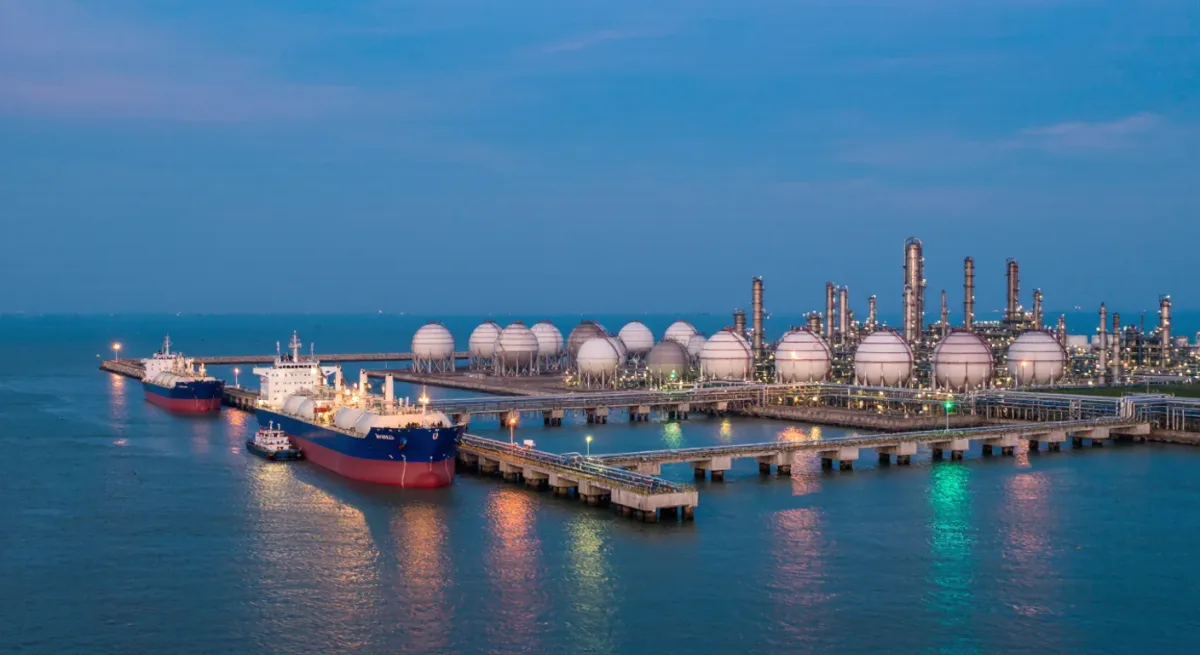
Liquefied natural gas is Qatar's economy in a single export: the country produces about 77 million tonnes a year, placing it among the world's top three exporters alongside the United States and Australia, and hydrocarbons supply the bulk of government revenue and export earnings. The 2026 attack on Ras Laffan industrial city underlined the concentration: damage to liquefaction Trains 4 and 6 knocked out about 17 percent of export capacity, roughly 12.8 million tonnes a year, with repairs estimated at three to five years, according to a Reuters report citing QatarEnergy.
Before the attack, the story was expansion. The North Field projects, North Field East, South and West, were set to lift capacity from 77 to 142 million tonnes a year by 2030, the largest liquefaction build-out ever attempted in Gulf energy markets. The damage complicates that timetable, and Qatar has not published a revised schedule, but the long-term bet on gas demand, especially from Asia, is unchanged in official statements.
How the money flows
QatarEnergy, the state producer, sells LNG under long-term contracts, historically oil-indexed, to buyers across Asia and Europe, alongside spot cargoes. Revenue flows to the state through QatarEnergy's earnings, royalties and the taxes and dividends of joint ventures with international partners, ExxonMobil, Shell, TotalEnergies, ConocoPhillips and others, each holding slices of the liquefaction trains.
| Layer | Role |
|---|---|
| North Field | The shared reservoir, among the largest gas fields in the world |
| Ras Laffan | Liquefaction and export complex, the world's largest |
| QatarEnergy and partners | Production, liquefaction, shipping |
| Buyers | Asian and European utilities under long-term contracts |
Why buyers cannot easily replace it
Qatar's LNG is cheap to produce, given the field's scale and shared infrastructure, and its contracts run for decades, which is why it supplies over two-fifths of India's LNG imports and holds similar weight in China, Korea and Japan's supply mixes. The 2026 disruption forced analysts to abandon forecasts of a well-supplied market and prompted discussion of force majeure declarations by QatarEnergy on affected volumes, as Indian buyers reported.
Gas prices spiked on the damage and stayed volatile through the year, a reminder that the global market treats Qatari outages as systemic events rather than local news. European buyers, competing for spot cargoes, felt the tightening first.
What the state does with the revenue
Gas receipts fund the budget, subsidise domestic energy, and feed the Qatar Investment Authority, the sovereign fund built on LNG surpluses. In fat years the surplus is exported into global assets; in thin years those assets and reserves buffer the budget. This is the standard Gulf model, but Qatar runs it with a narrower industrial base: outside energy and its services, the private economy is smaller relative to neighbouring financial centres.
The 2026 damage bill, estimated by QatarEnergy at up to $20 billion a year in lost revenue according to Reuters, tests the model's insurance: a multi-year revenue hit against a sovereign fund built precisely for such shocks.
Qatar's gas history in four moves
The industry's shape follows four decisions. First, the discovery and development of the North Field, the giant reservoir Qatar shares with Iran, through the 1970s-90s. Second, the bet on liquefaction at scale in the 1990s, when Sheikh Hamad bin Khalifa's government committed to trains that made Qatar the largest LNG exporter by the mid-2000s, the transformation covered in our obituary coverage of the former emir's era. Third, the moratorium years, when Qatar froze North Field expansion from 2005 to 2017 while it studied reservoir behaviour, a pause that shaped global supply for a decade. Fourth, the expansion unleashing after 2017: North Field East, South and West, lifting capacity toward 142 million tonnes a year, the programme that regional rivals answered with their own projects and that 2026's damage interrupted but did not cancel.
| Phase | Rough period | Effect |
|---|---|---|
| North Field development | 1970s-1990s | Resource base established |
| LNG bet | 1990s-2000s | World's top exporter |
| Moratorium | 2005-2017 | Supply held flat |
| Expansion era | 2017-2030s | Capacity toward 142 mtpa |
For a single-generation tour of how a resource endowment becomes a state, Qatar's arc is the region's cleanest case study, and the current repair-and-expand phase is its fourth chapter rather than a break from it.
The buyers, named and ranked
The contract map concentrates in Asia. China is the largest single buyer, taking multiple million tonnes a year under long-term agreements with the state energy companies; India follows, with Qatar supplying over two-fifths of its LNG imports across contracts with firms like Petronet; Korea and Japan hold decades-old relationships that anchor the eastern book. Europe's share grew sharply after 2022, when Qatar redirected volumes and signed multi-year agreements with European majors, and the continent became the swing buyer whose spot demand sets the marginal price. Pakistan, Bangladesh and Thailand hold smaller but strategically vital contracts, and the 2026 supply loss forced each into the expensive spot market, which is how a strike on one industrial complex in the Gulf raised electricity costs in South Asia within the same shipping cycle.
The rebuild and the expansion
Repairing Trains 4 and 6 runs on a three-to-five-year horizon, while the undamaged expansion trains continue construction. Qatar's strategic response to the 2026 attack, in public statements, has been continuity: honour contracts from surviving capacity, repair methodically, and complete the build-out that pushes output toward 142 million tonnes by decade's end. For how such state capital is deployed abroad, see our explainer on Gulf sovereign wealth funds.
The honest summary: Qatar is a gas company with a country attached. That concentration produced one of the highest incomes per head on earth, and in 2026 it produced the year's sharpest lesson in single-asset risk.