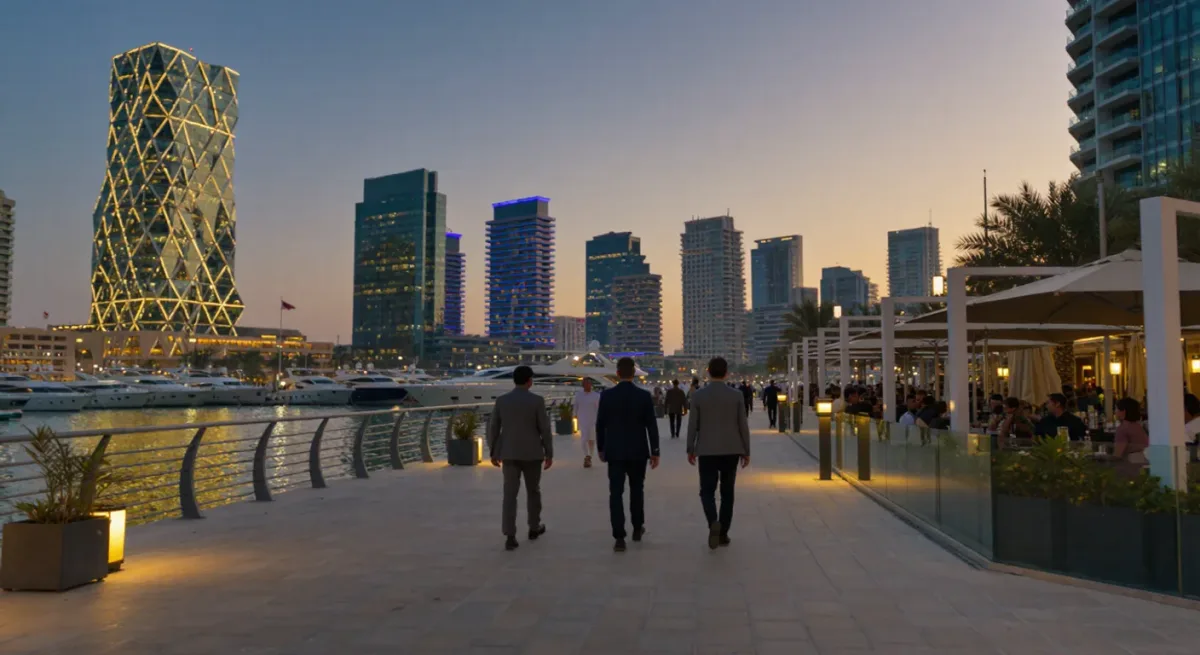
A single professional in Dubai can live comfortably on AED 10,000 to 14,000 a month; a family of four typically needs AED 22,000 to 35,000 before school fees, which add AED 20,000 to 100,000-plus per child per year. Those figures, drawn from published school-fee schedules and listing data, describe a city that is no longer the bargain expatriates found a decade ago, but which remains free of personal income tax.
Dubai's cost structure is dominated by two lines: rent and education. Everything else, transport, food, utilities, is negotiable through lifestyle. The city's statistics centre has tracked consumer inflation in low single digits in recent years, but housing cycles move in steps, and the 2022-24 rent surge reset life in Dubai's baseline budgets more than any inflation print captured.
Housing: the line that decides everything
| Property | Typical annual rent range |
|---|---|
| Studio, older districts (Deira, Al Qusais) | AED 30,000-45,000 |
| One-bedroom, JLT or Business Bay | AED 65,000-95,000 |
| One-bedroom, Marina or Downtown | AED 90,000-130,000 |
| Two-bedroom villa, Springs or Meadows | AED 170,000-230,000 |
Rents are quoting ranges from listing portals and move with building age and metro proximity. Payment is by cheque, commonly one to four per year, which forces cash planning that monthly-rent cities never require.
Schooling, the second budget-breaker
Private schooling is the default for expatriate children, and Dubai's education regulator publishes the fee schedule every school is permitted to charge. Published fees range from under AED 20,000 a year at value Indian-curriculum schools to well over AED 100,000 at premium British and IB schools. Families migrating mid-career often find the fee delta, not the salary delta, decides which offer to accept.
Everything else
- Transport: a metro commute with an Nol card costs a few hundred dirhams a month; a used sedan adds fuel, Salik road tolls and parking, together AED 1,200-2,000 monthly.
- Utilities: DEWA electricity and water runs roughly AED 500-1,000 for apartments; district cooling adds to it in towers; summer bills spike with air conditioning.
- Food: a mixed pattern, AED 300-500 a week per person cooking at home with mid-range groceries; district cafés and brunch culture are as expensive as any Western city.
- Health insurance: mandatory, employer-provided for most workers; family plans bought privately run AED 5,000-15,000 a year.
- Leisure: gym, beach clubs and cinema together AED 800-1,500 monthly, highly elastic.
How the tax-free arithmetic works
The counterweight to every bill above is that Dubai levies no personal income tax. A salary quoted here is a salary received here. For a mid-career professional on, say, AED 25,000 a month, the absence of income tax against Europe or India is worth several thousand dirhams monthly, which is why savings rates in Dubai, examined in our guide to how much expatriates can save in the Gulf, can exceed home-country equivalents even after higher rents.
The neighbourhood effect on the budget
Where you live changes every other line, and the differences are larger than rent alone suggests. A studio in Deira or Al Qusais sits on the metro's Green Line, walks to inexpensive food and trades the marina's brunch economy for a quieter one, so the same salary stretches further twice, once on rent and once on the spending the district invites. A Marina address adds the views, the walkability and the pull of a high-spending social rhythm that quietly adds thousands of dirhams a month for singles who follow it. Families face the sharper version of the trade: villa communities bundle space and schools access but assume cars; metro-adjacent apartments flip the equation. The single best budgeting decision most newcomers make is matching the district to their actual habits rather than their aspirational ones.
What employers typically cover, and what they do not
Package arithmetic decides family budgets more than salary headlines. Two offers differing by a few thousand dirhams a month can reverse ranking entirely once school-fee support, family insurance and housing allowances are counted, and the published fee and insurance schedules above are the ones to run through that comparison before accepting anything.
| Item | Common practice |
|---|---|
| Housing allowance | Often quoted as a salary multiple or monthly sum; verify annually |
| Health insurance | Employer-provided for employees; family cover varies |
| School fees | Rarely covered in full; some senior packages include it |
| Annual flights | Common once a year for the employee, sometimes family |
| Utilities | Usually the tenant's responsibility |
Package arithmetic decides family budgets more than salary headlines. Two offers differing by a few thousand dirhams a month can reverse ranking entirely once school-fee support, family insurance and housing allowances are counted, and the published fee and insurance figures above are the ones to run through that comparison before accepting anything.
Living well for less
Insurance is the line families most often under-budget: employer cover applies to the employee, and family plans bought privately at AED 5,000-15,000 a year belong in the comparison from the first month, not the first claim.
The city rewards planning. Rents fall measurably a metro stop or two from marquee districts. School value tiers are wide, and curriculum choice is the largest single lever. Utility discipline in summer, second-hand furniture markets and the January sales cycle all compound. Residents who treat the tax-free margin as savings, rather than lifestyle float, consistently report the best outcomes.
The honest summary: Dubai costs what you let it cost. The floor for a single person is genuinely modest, the ceiling is global-city high, and the two fixed lines, rent and school fees, are the ones to negotiate before accepting any offer.