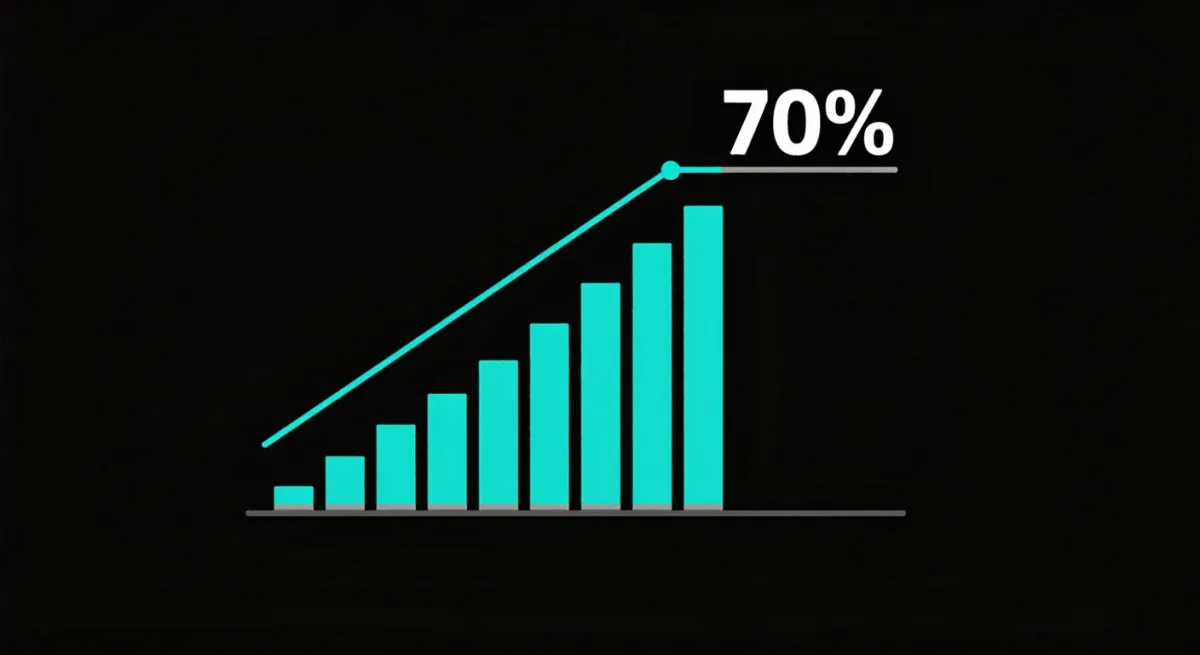
Sakani is Saudi Arabia's national housing programme: a digital platform run under the Ministry of Municipal and Rural Affairs and Housing that allocates residential land, subsidised mortgages and developer-built homes to Saudi families. Its purpose is measured by one number: the Vision 2030 target of raising Saudi homeownership to 70 percent by 2030, from roughly 47 percent when the programme launched in 2017.
Ownership rates have climbed since. Official statements put Saudi homeownership above 63 percent in recent years, a jump delivered mostly through the Saudi housing market's subsidised finance channels rather than through open-market cash purchases.
How the platform works
Families register on the Sakani portal and are scored for eligibility. The platform then routes them into one of several tracks: free or subsidised residential plots with self-build options, ready units from contracted developers, or apartments and villas under the ministry's partnership programmes with private builders. Once a product is selected, the application moves to financing.
The platform acts as a matching engine between three sides: eligible families, private developers who commit inventory at agreed price points, and banks and finance companies that fund the mortgages. This structure is why Sakani is better understood as state demand-subsidy infrastructure than as a developer or a lender.
The finance layer: Wafi and the Real Estate Development Fund
The money sits in the Wafi programme, under the Real Estate Development Fund. Wafi channels profit-rate support through commercial banks: the state pays part of the margin, so the borrower's effective profit rate on qualifying contracts has been advertised well below prevailing market rates on some products. Contracts are Sharia-compliant, consistent with Saudi banking law.
Since Wafi's introduction, the programme has approved subsidy packages worth tens of billions of riyals across hundreds of thousands of contracts, according to housing ministry announcements. Banks compete for allocation windows because the state guarantee makes the exposure attractive.
What it changed for developers
Before Sakani, the Saudi market produced little mass-market housing: land speculation left plots empty while affordability gap kept buyers out. The programme forced a product pivot. Developers now design two- and three-bedroom villas and apartments to price caps that fit subsidised repayment capacity, and they presell into allocated demand rather than speculating on open-market buyers.
| Sakani track | What the family gets |
|---|---|
| Residential land | Free or subsidised plot with a self-build route |
| Ready developer units | Price-capped villas and apartments from contracted builders |
| Subsidised finance (Wafi) | Profit-rate support through commercial banks |
| Off-plan (regulations permitting) | Staged payments on qualified projects |
The mortgage connection
Sakani's subsidy does not remove credit assessment. Banks still apply central bank rules on lending, down payments and debt-service ratios, and the size of the subsidy a family qualifies for depends on income. The mechanics of those mortgages, including loan-to-value caps for first homes and the profit rates that track Saudi money-market benchmarks, are covered in our explainer on how much a Saudi mortgage costs.
How the digital platform changed the paperwork
Sakani's less visible achievement is administrative. Before the platform, a Saudi family pursuing subsidised housing navigated the housing ministry, the Real Estate Development Fund, the land registry and a bank, each with separate queues and paper files. The platform collapsed that journey into a single digital record: eligibility is scored automatically from national data, product allocation, land, ready units or construction packages, is executed online, and financing applications route directly into partner banks' systems with the subsidy pre-attached.
The self-build track illustrates the change. A family allocated a plot can select contracted builders, house designs from a standardised catalogue and staged construction supervision through the platform, with payments released against inspection milestones in a structure copied, deliberately, from the escrow logic used in the private off-plan market. Municipal inspections and utility connections are scheduled through the same record. The design catalogue matters commercially: it concentrates demand for standardised two- to four-bedroom homes, which is why national contractors and smaller regional builders alike have reorganised product lines around Sakani-eligible specifications.
The programme's critics, in summary
Opposition to Sakani is rarely about the subsidy itself. The recurring critiques are three. Beneficiary experience: families report waiting periods between allocation and financing that stretch across quarters, and complaint channels that work slowly. Spatial outcomes: subsidised demand has inflated land prices around serviced plots, transferring part of the subsidy to landowners, a dynamic Saudi economists have documented. And market dependence: the volume housing market now leans on a single state programme, so any slowdown in subsidy windows slows the entire residential construction sector, an interdependence officials acknowledge when they describe the programme as too large to pause. Each critique is answerable, and none reverses the programme's delivery record; together they define the reform agenda for the 70 percent endgame.
Where the 70 percent target stands
The programme's momentum is real but uneven. Subsidised lending has grown the fastest in the interior regions, where land is cheap and self-build dominates, while Riyadh and Jeddah affordability depends more heavily on apartment supply. Officials have acknowledged that the last tranche of the target, from the mid-60s to 70 percent, is the hardest, because it reaches lower-income households where even subsidised repayment capacity is thin.
For regional comparators, Sakani has no exact equivalent: the UAE subsidises demand through residency rather than finance, and Qatar's rental-heavy model requires no ownership programme at all. That uniqueness is the point. Saudi Arabia chose to mass-manufacture homeowners because its social contract, demographics and unused construction capacity aligned, and the programme is the region's clearest experiment in using housing finance as economic policy.
For the property industry, Sakani defines the mass-market segment in Saudi Arabia. Any volume residential strategy in the kingdom today is, in practice, a strategy for selling into, building for, or financing alongside this programme.