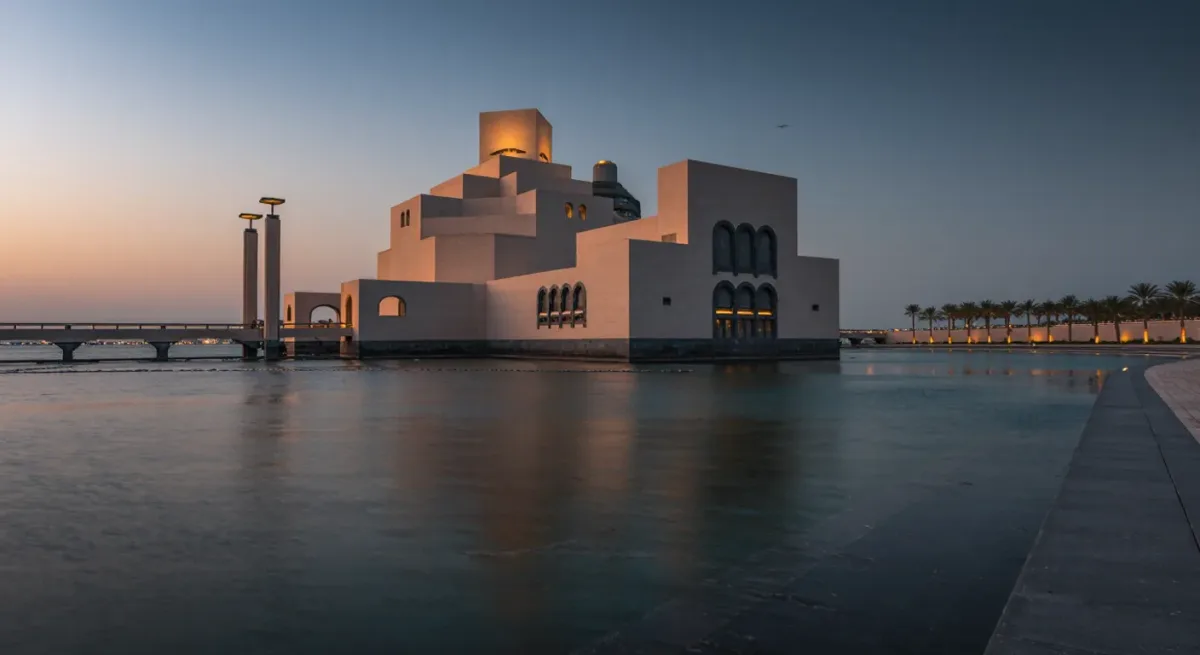
Doha's museum district holds four institutions of international weight: the Museum of Islamic Art, designed by I.M. Pei and opened in 2008; the National Museum of Qatar, Jean Nouvel's interlocking-disc building from 2019; Mathaf, the Arab Museum of Modern Art; and the 3-2-1 Qatar Olympic and Sports Museum, opened in 2022. All sit within a few kilometres of the Corniche, and all are state-funded through Qatar Museums, the authority chaired by Sheikha Al Mayassa bint Hamad Al Thani.
The collection strategy is decades old and deliberate: gas wealth was converted into art and artefacts at scale, from Islamic manuscripts to Rothkos and Modiglianis acquired in the 2000s and 2010s. For visitors, the result is a compact, high-density Gulf cultural itinerary that can be walked in two full days.
The four, in order of importance
Museum of Islamic Art. Pei's last major commission, a limestone stack on its own island at the Corniche's end. The collection spans fourteen centuries of manuscripts, metalwork, ceramics and carpets and remains the Gulf's single best museum. Admission is free, and the MIA Park behind it hosts public installations and weekend markets.
National Museum of Qatar. Nouvel's desert-rose discs house the country's story, from natural history through pearl diving to the gas era. The delivery is theatrical, and the building itself is the headline. The palace of Sheikh Abdullah bin Jassim, incorporated into the site, connects the display to the state's founding era.
Mathaf. The Arab world's modern and contemporary collection, strongest in twentieth-century painting from Egypt, Iraq and Lebanon alongside Gulf artists. It lives in a converted school in Education City, which adds the Qatar Foundation campus's architecture to the same trip.
3-2-1. The sports museum, opened for the World Cup year, is a serious Olympic-grade collection rather than a fan attraction, with athletics, football and motorsport galleries.
How to do it
| Stop | Allow | Notes |
|---|---|---|
| Museum of Islamic Art | 3 hours | Free entry; go early for light on the Corniche side |
| National Museum of Qatar | 2-3 hours | Timed tickets; combine with Souq Waqif opposite |
| Mathaf | 2 hours | Pair with Education City mosques and campuses |
| 3-2-1 | 2 hours | At Khalifa International Stadium |
The district around them
The museums anchor a wider cultural quarter. Souq Waqif, restored in the 2000s, sits directly opposite the National Museum and handles food, spices and falconry shops. Al Bidda and the Corniche parks connect the walking routes. Qatar Museums has since layered on Design Doha, a design biennale that debuted in 2024 and returned with 2026 programming, extending the district's calendar beyond archaeology and fine art.
Why it matters beyond tourism
Qatar's museum-building served the state's soft-power strategy: exhibitions lent globally, museum partnerships with the Louvre and others, and a permanent cultural argument for the country's place in regional affairs. For the resident and business visitor, the practical effect is simpler: Doha has more world-class museum hours per square kilometre than any Gulf city, and the off-meeting afternoon is genuinely well spent there.
Visitors planning the wider winter circuit can bracket Doha's calendar against Saudi Arabia's festival season using our guide to Riyadh Season.
The collecting story behind the district
The museums are the visible layer of a three-decade acquisition campaign. In the 2000s, Qatar's buying was the art market's open secret: record-setting purchases of Rothko, Bacon and Cézanne works, the 2011 record for a Cézanne Card Players among the most reported, flowed into state holdings curated for institutions then unbuilt. The strategy, driven by the ruling family's cultural leadership, deliberately front-loaded collections so the museums would open with encyclopedic depth rather than promise. The Museum of Islamic Art's holdings, manuscripts, astrolabes, carpets and ceramics spanning fourteen centuries, assembled partly through the great private collections of the twentieth century's collecting era, anchor a story the Gulf states tell as their own: Islamic civilisation's material record, curated in the Gulf rather than only in London or Paris.
Contemporary collecting followed, and Mathaf's collection of modern Arab art, thousands of works assembled around a foundational private holding, gave the region's twentieth-century painters a permanent institutional home that had largely existed only in Beirut and Cairo before. For a visitor, knowing the collecting history explains the district's density: these are not museums that grew slowly from local donations but institutions built quickly and completely, the cultural equivalent of the gas-fuelled skyline behind them.
Education City and the wider cultural arc
The museum district extends west into Education City, the Qatar Foundation campus where branch campuses of foreign universities, a convention centre and the Sheikh Abdulla bin Zayed museum-lined avenues make a second cultural itinerary. Together with the World Cup infrastructure inherited from 2022, Doha's cultural offer now spans museums, sport and education in one compact geography, a deliberate design that rewards the visitor who plans by district rather than by single site, and a soft-power asset the state deploys at every diplomatic turn, as the 2026 mourning period's procession of world leaders quietly demonstrated.
Practical notes
Two half-days or one full weekend covers the core four with comfort; adding Education City makes it a full weekend, and the compact geography means no itinerary needs a car for more than a single leg.
- Check Qatar Museums' site for current hours and Ramadan schedules, when hours shift to evenings.
- MIA is free; the National Museum charges modest admission; annual passes cover the circuit.
- Taxi or ride-hailing connects all four institutions in under twenty minutes each.
- Photography is permitted in most galleries without flash; some loan exhibitions restrict it.
One summary sentence: Doha spent its gas dividend on architecture and collections, and the visitor inherits the results, stacked along one bay.