The culture and lifestyle of Rajasthan is built around three things: forts, faith and the desert that shapes both. India's largest state by area covers 342,239 square kilometres, most of it the Thar Desert, and about three-quarters of its people still live in rural areas, per Wikipedia's state profile. That geography explains a great deal — the water-saving architecture, the wheat-and-lentil diet, the festivals that fill a thin harvest calendar.
The state was formed on 30 March 1949, when the princely states of the old Rajputana Agency merged into the new Indian Union. Its name means "Land of Kings", and the kings left behind something unusual: a heritage stock so large that much of it is still inhabited, still visited, still traded around. This guide sets out what that culture looks like in practice — the buildings, the food, the faith, and the tourism economy that now runs through heritage towns.
It sits in a wider series on regional culture. Readers comparing Indian states may also find the Culture and Lifestyle of Kerala useful, since the two states make an instructive contrast: one built on backwaters and coasts, the other on sandstone and scarcity. For the wider region, the Culture & Life section tracks similar heritage-economy stories in the Gulf. Readers following this should also see Culture and Lifestyle of Kerala — Kerala's Culture and Lifestyle: How Old Traditions Meet Modern Life.
What defines the culture and lifestyle of Rajasthan?
Three forces define it: a royal history, a desert climate, and a mostly rural population. The state's name translates as "Land of Kings", and its cities grew around Rajput kingdoms established in western India from the first millennium onward, according to the historical record summarised on Wikipedia. The desert dictated the rest. Water was scarce, so houses thick-walled and inward-facing; food was built on grains and ghee that keep in heat; travel ran on camels and caravan routes.
The result is a lifestyle that prizes endurance and display in equal measure. Forts and palaces carry the display. The daily routines — drawing water, tending livestock, working crafts — carry the endurance. Hindi is the official language and English an additional official one, per the state profile, but the region's own Rajasthani dialects dominate daily life in towns and villages.
Why do the forts matter so much?
Because they are not ruins. They are the state's most recognisable landmarks and, in several cases, still working parts of their cities. Per Incredible India, the national tourism authority's official portal, the Amber Fort above Jaipur is a leading example of Rajput architecture, overlooking Maota Lake, while Udaipur's City Palace is a complex of palaces, courtyards and gardens above Lake Pichola. Jodhpur's Mehrangarh Fort stands on a rocky hill above the city, and Jaipur's Hawa Mahal — the five-storey "Palace of Winds" — was built so royal women could watch street processions unseen.
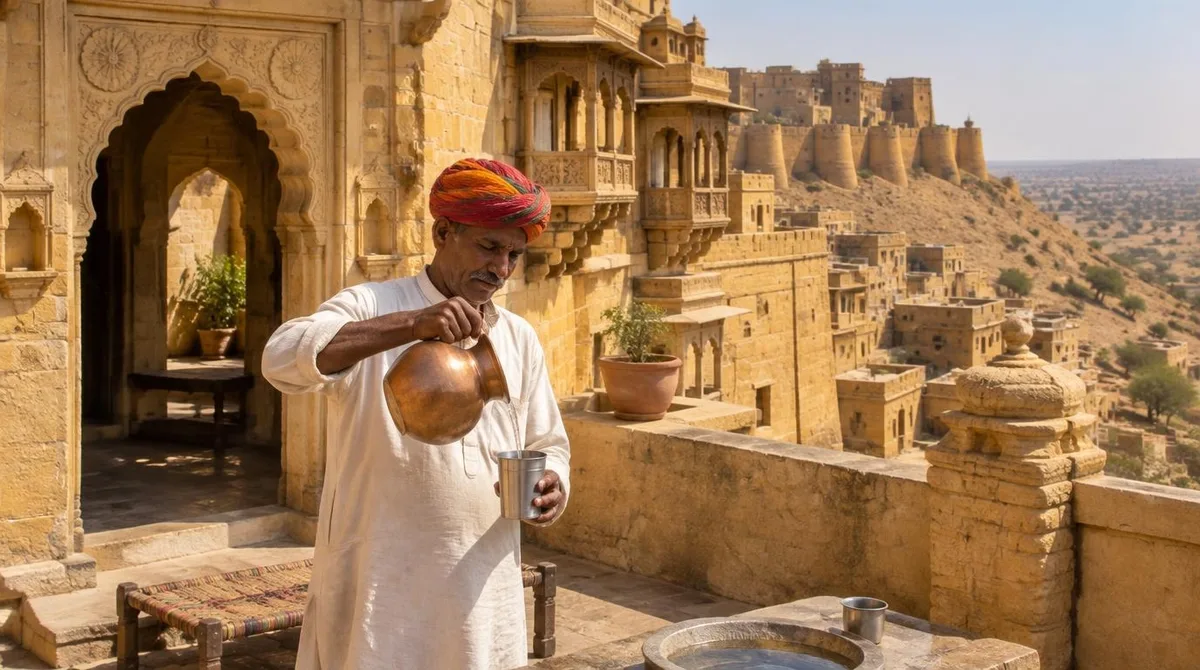
Chittorgarh Fort, one of the largest forts in India per the same official source, is tied to Rajput stories of bravery. Jaisalmer's fort is different again: it sits in the heart of the Thar Desert, built of golden sandstone, with havelis (merchant mansions) such as Patwon Ki Haveli nearby. The point for a visitor or a student of the region is that these buildings anchor the towns' identities. Jaipur is known for its pink-hued buildings; Jodhpur for its blue-painted houses; Udaipur is often called the "Venice of the East" for its lakes and palaces.
What do people eat, and why is the food built that way?
Rajasthani food reflects two constraints: royal kitchens and an arid landscape. Per Incredible India, the signature dish is dal baati churma — round wheat-flour bread (baati) served with spiced lentil curry (dal) and a sweet, crumbly mixture of wheat flour and sugar (churma). It is a desert dish: wheat keeps, ghee keeps, and the bread can be baked without much water.
Other staples carry the same logic. Laal maas is a fiery mutton curry built on red chillies. Mirchi vada is a green chilli stuffed with spiced potato, coated in gram-flour batter and fried. Ghevar, a disc-shaped sweet of flour, sugar and ghee, appears at festivals such as Teej and Raksha Bandhan. Nothing about the cuisine is subtle, and that is the point — spice and fat did jobs that refrigeration could not.
How does faith shape daily life?
Religion is public, calendrical and place-specific. Pushkar, a sacred town centred on Pushkar Lake, holds ghats (riverside steps) and temples that make it a pilgrimage destination, and it is famous for the only Brahma temple in the world, per the official tourism portal. Mount Abu, the state's only hill station, is a Jain pilgrimage site in the ancient Aravalli range, and the state also holds the Dilwara Temples there.
Festivals organise the year. Gangaur, celebrated with particular enthusiasm in Udaipur, is a women-centric festival in which participants dress in colourful attire and carry idols of the goddess Gauri in procession. Diwali, the festival of lights, illuminates Jaipur on a large scale. And the Pushkar Camel Fair turns faith into fairground: thousands of camels, horses and cattle are traded alongside folk music, dance and competitions. The fair is both a livestock market and a cultural event — a useful window into how rural and sacred life still overlap.
How did tourism reshape the heritage towns?
Tourism turned heritage into an economy, and it did so unevenly. The official portal now markets camel and jeep safaris, hot-air balloon rides and even zip-lining from the ramparts of Mehrangarh Fort — activities that barely existed when the forts were simply residences. Heritage towns such as Jaisalmer and Pushkar built visitor infrastructure around their old cores, and the trade is visible in the bazaars the portal itself describes as bustling.
The reshaping is not only commercial. Conservation follows footfall: forts that might have decayed became museums, hotels and ticketed sites. That brings money and preservation, and it also brings crowds and pressure on small towns built for far fewer people. Our analysis: Rajasthan's bet resembles the Gulf's heritage bets in miniature — the state monetised its past rather than demolishing it, and the tension between visitor economy and living town is now the central management question in places like Jaisalmer and Pushkar. This connects to our earlier piece, Doha's museums: a visitor's guide.
The wildlife end of tourism points the same way. Keoladeo National Park at Bharatpur, a UNESCO World Heritage Site, is home to more than 370 bird species, per Incredible India. Ranthambore is one of India's best-known tiger parks, and the Desert National Park near Jaisalmer protects the rare great Indian bustard. Five national tiger reserves sit in the state, per the state profile on Wikipedia. Nature tourism gives the desert economy a second leg beyond forts and fairs.
What should a visitor take from all this?
Plan around the desert, not against it. The practical pattern the sources suggest: base yourself in one of the four heritage cities — Jaipur, Jodhpur, Udaipur or Jaisalmer — and let the forts, lakes and bazaars structure the trip, with Pushkar or Mount Abu as a faith-and-climate detour. Food is part of the itinerary, not an afterthought; dal baati churma and laal maas are the dishes the state's own tourism authority leads with.
What the sources establish is the shape of the place: a large, mostly rural desert state whose royal architecture, religious calendar and food traditions form one system, now partly converted into a visitor economy. What they do not establish is how that economy distributes its gains, or how the smaller heritage towns are coping with growth. Those are reporting questions, and they are where the next story lies.