The culture and lifestyle of Kerala rest on three things: a festival calendar that still runs village life, a long reading and learning habit, and money sent home by workers in the Gulf. Kerala is a state on India's south-west coast, formed on 1 November 1956 from the region's Malayalam-speaking areas, according to Wikipedia. About 36 million people lived there in 2025.
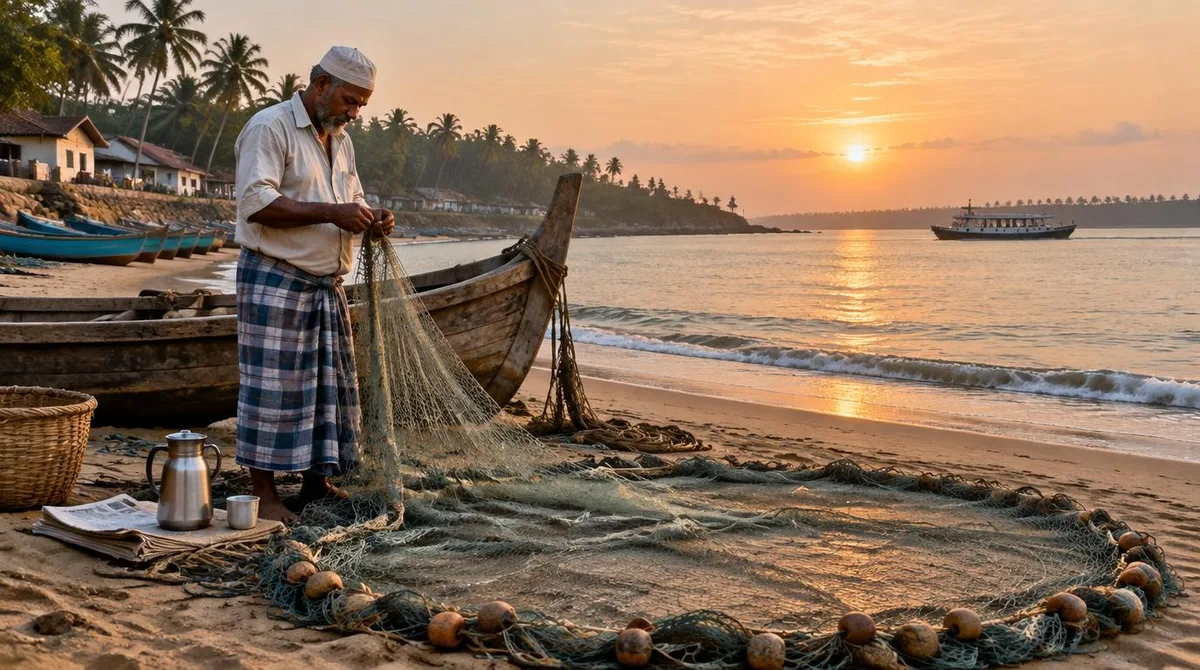
The state is a narrow strip of land. The Western Ghats hills stand on one side and the Arabian Sea on the other. Its coastline runs 595 kilometres, and the sea still feeds a large share of its people: 1.1 million Keralites depend on fishing, which brings in around 3 percent of the state's income, per the same source.
For Gulf readers, Kerala matters twice over. It is one of the main sources of the region's expatriate workforce, and its economy leans heavily on the money those workers send home. The state saw large emigration to the Arab states of the Persian Gulf during the boom of the 1970s and early 1980s, and remittances remain a pillar of the economy, as Wikipedia's overview of Kerala records. Readers following this should also see How working hours change during Ramadan in the Gulf.
What festivals shape the year in Kerala?
Two festivals anchor the calendar. Onam is the harvest festival, and Vishu marks the Malayalam calendar's new year. Temples and churches hold their own festivals through the year, and a common tradition runs through them: a holy flag is raised at the start and brought down on the last day, according to the Simple English Wikipedia entry on Kerala.
Temple festivals called poorams sit at the louder end of the year. The best known is Thrissur Pooram, which pairs firecrackers with traditional performance forms such as Theyyam, Kathakali and Chakyar Koothu. Festivals are known locally as utsavams. They are not staged shows for visitors. They are the dates around which families plan travel, temple visits and meals.
Performance traditions run deeper than the festival days. Kathakali, a Hindu performance art, and Kalaripayattu, an old martial art, are among the forms the state is known for. Music leans on percussion, and the same source notes that people also follow football, cricket and badminton with close attention.
Why does Kerala read so much?
Kerala's literacy rate stood at 95.3 percent in 2024, among the highest in India, according to Wikipedia. Malayalam is the state's official language alongside English, and more than 90 percent of people can read Malayalam, the simpler-language entry records.
Reading is a daily habit, not just a statistic. The Simple English Wikipedia entry notes that most people have access to the internet, television, newspapers and books, and that average reading time runs about seven hours a week. Kerala also has the highest media exposure in India, with newspapers published in nine languages, mostly Malayalam and English.
That habit shows in public life. Debate, cinema and literature carry weight in the state's towns, and a newspaper is as much a part of a morning as the tea. What this means for visitors is simple: conversations start with books, politics and football, not small talk.
How does Gulf migration shape everyday life?
The money trail runs west. From the 1970s onward, waves of Malayalis took jobs across the Persian Gulf, and their remittances became a load-bearing part of the state economy. Wikipedia describes Kerala's economy as relying heavily on remittances from a large Malayali expatriate population.
The effects reach past bank accounts. Houses are built with Gulf earnings. Weddings, school fees and small businesses are funded by them. Families split across two shores keep two calendars: the festival dates at home and the leave schedules of a worksite in Dubai or Riyadh. Readers weighing a Gulf stint against what it can save can see the wider money picture in how much expatriates can save in the Gulf. We covered a connected angle in How much can expatriates save in the Gulf.
Migration also changed the landscape. Towns along the coast carry Gulf-built homes and Gulf-funded schools. The traffic between Kerala and the Gulf runs in both directions now, carrying people, money and tastes in food, shopping and building style.
What are the matrilineal legacies still visible today?
Parts of Kerala, and neighbouring coastal districts, followed matrilineal customs for centuries. Under these systems, family descent and property passed through the mother's line, and the eldest maternal uncle often managed household affairs. The practice has largely faded as law and family life modernised, but its marks remain.
They show in the old courtyard houses built for joint families, in the prominence of women in public life, and in the state's social indicators. Kerala's sex ratio stood at 1,084 women per 1,000 men in 2025, the highest in India, per Wikipedia. Its Human Development Index was 0.804 in 2023, rated very high and second among Indian states.
None of that is a single legacy of matriliny. But a state where women outnumber men, where nearly everyone reads, and where daughters inherit in memory if not in deed, reads differently from most of the region around it.
What does daily life look like on the coast?
Daily life splits between water and town. The backwaters, a network of lagoons and canals, still move goods and people, and houseboats now carry visitors through them. Beaches line the coast, and hill stations sit in the Ghats above. National Geographic Traveler named Kerala one of the ten paradises of the world, and the state remains one of India's leading tourist draws, according to Wikipedia.
Towns keep pace with the rest of India. Kochi, the most populated metropolitan area, carries malls, busy streets, festivals and nightlife, the Simple English Wikipedia entry notes. Spice trading, the trade that drew Portuguese ships here in the 15th century and older merchants long before, still runs through the ports. Kerala has exported spices since 3000 BCE, the same source records.
Food follows the crops: coconut in everything, jackfruit, rice from the paddies, and fish from the coast. Ayurvedic treatment, the traditional medicine system, draws health visitors alongside the tourists.
Why Kerala's balance holds
Kerala's lifestyle works because the old and the new share the same small strip of land. A temple festival draws the town at night; a remittance-funded apartment block rises next door. The evidence points one way: high literacy, high life expectancy and a festival calendar that has not given way to the mall. What remains unclear is how long the remittance pillar holds as Gulf labour markets change. For now, the state keeps both calendars, and both pay their bills.